

Engineering the Pouch
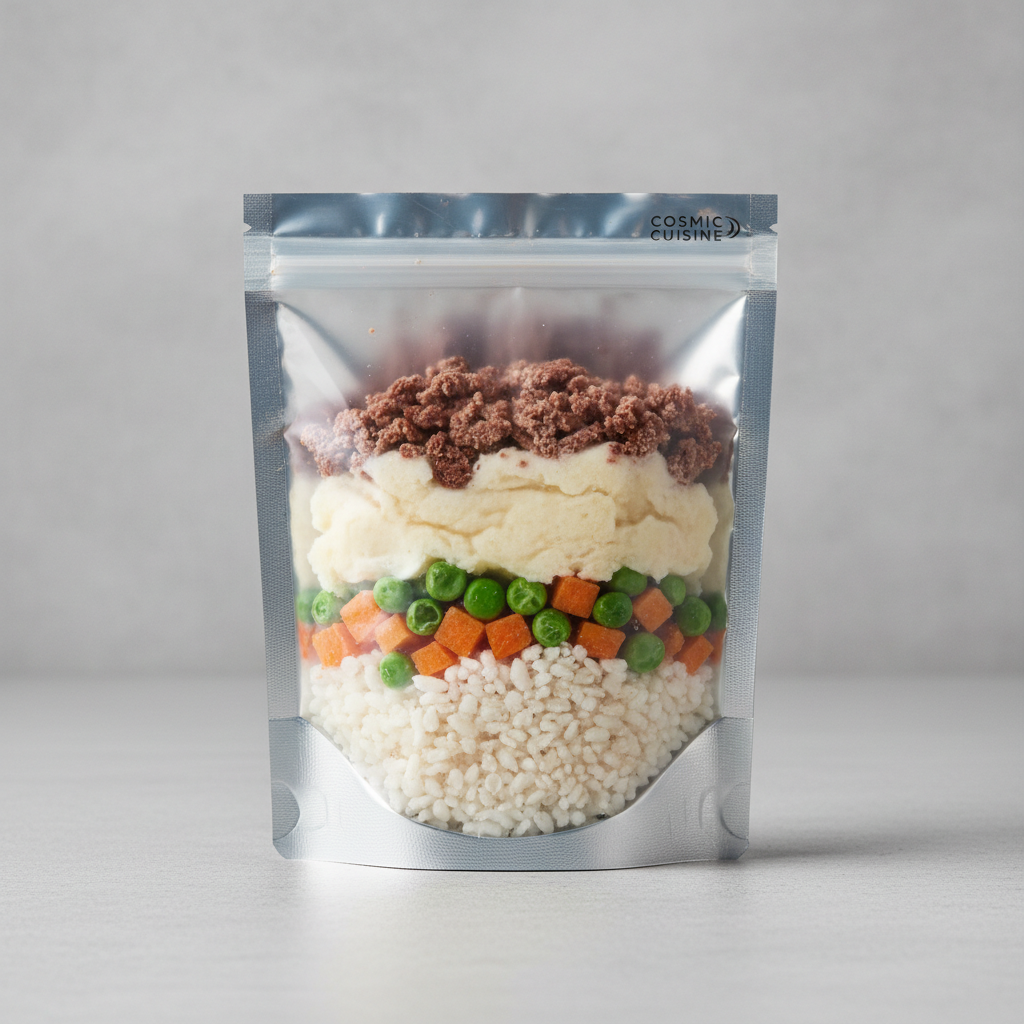
Whey isolate + casein blend, radiation-stable
Maltodextrin + oat flour, low glycemic index
Microencapsulated DHA/EPA, oxidation-resistant
Ca²⁺ + Mg²⁺ + Vit D3 — counteracts microgravity loss
Inulin + FOS — maintains gut flora in closed systems
All formulations validated against NASA-STD-3001 Vol. 2 nutritional requirements for long-duration spaceflight. Payload mass optimized to ≤ 1.8 kg/crew-day.
Research Bay
Gut Microbiome Dysbiosis in Simulated Microgravity: A 90-Day Longitudinal Analysis
Analog microgravity environments produced measurable shifts in Firmicutes/Bacteroidetes ratios within 21 days of simulated weightlessness, with significant implications for nutrient absorption efficiency in long-duration crews.
Bacteroidetes abundance decreased 31% vs. baseline; dietary fiber supplementation (12g/day inulin) partially reversed dysbiosis by day 42.
Double-blind crossover study, n=24 healthy adults, 6-week head-down tilt bed rest protocol. 16S rRNA sequencing at days 0, 21, 42, 90. Dietary intake controlled via standardized ISS-analog meal protocol.
Bone Mineral Density Preservation Through Calcium-Fortified Freeze-Dried Rations: ISS Expedition 68 Data
Crew members receiving calcium-enhanced ration packs (1400mg Ca/day) showed 23% lower trabecular bone loss at the lumbar spine compared to standard ration controls after 180-day missions.
1400mg/day calcium with co-administered Vit K2 (200μg) showed synergistic protection; effect size Cohen's d = 0.74.
Retrospective cohort analysis of DXA scan data from ISS Expeditions 65–68. Dietary logs cross-referenced with galley manifest records. Statistical analysis via mixed-effects linear regression.
Psychological Palatability and Monotony Index in Repeated Exposure to Identical Meal Protocols
The Monotony Index, a novel composite score of sensory fatigue and meal acceptance, declined 44% after 30 days of identical meal rotation in isolation chamber studies, correlating significantly with caloric intake reduction.
Meal variety ≥14 unique items per rotation cycle maintained Monotony Index above clinical threshold; below 8 items, voluntary caloric intake dropped 18%.
Prospective isolation study, HERA (Human Exploration Research Analog) Campaigns 5–7. n=32 participants, 45-day isolation. Daily palatability ratings (VAS scale), caloric intake measured, psychological battery administered weekly.
Cargo Manifest
Long-Duration Crew Nutrition Protocol v3.2
Complete dietary framework for missions 180–360 days. Includes macro targets per mission phase, supplement schedules, and bone density intervention thresholds.
Payload Mass Optimization Spreadsheet
Caloric density vs. payload mass trade-off calculator. Input crew size, mission duration, and metabolic rates — outputs optimal ration manifest with mass budget.
Gut Microbiome Field Guide for Flight Surgeons
Evidence-based dietary interventions for microbiome maintenance in closed-loop environments. Includes probiotic protocols and fiber supplementation schedules.
Download the Mission Nutrition Archive
47 peer-reviewed studies, 12 mission diet protocols, 8 caloric planning tools, and 6 payload optimization frameworks — compiled from ISS Expeditions 55–70 and analog mission research.